The problem with influencer marketing: you cannot see what you are buying
KolsHub is a platform that helps brands vet influencers before they pay. The premise is a real frustration in the market: a profile with a hundred thousand followers may have bought engagement, an audience in another country or auto-generated comments — and the brand only finds out after the money has moved.
The audience is marketers and business owners who have already been burned once, or who are about to run their first collaboration and do not want to get it wrong.
The strategy: give value before asking for anything
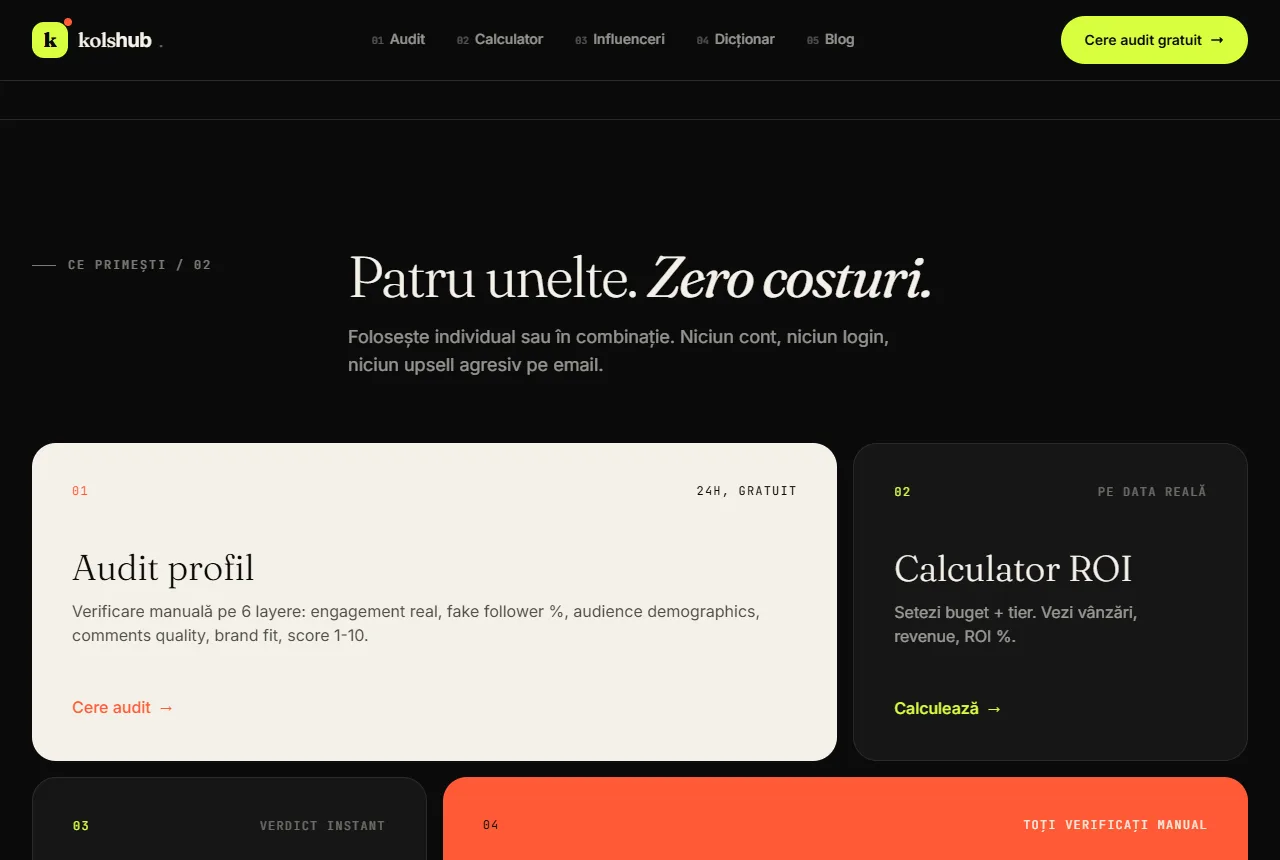
In a market where everyone demands an account and an email before showing anything, the chosen positioning is the opposite. The site says it plainly: four tools, zero cost. And it keeps going, just as explicitly — no account, no login, no aggressive email upsell.
It is a trust-before-transaction strategy: let people use the tools, let them see they are good, and only then have the commercial conversation.
“Four tools. Zero cost. No account, no login, no aggressive email upsell.”
The four tools
The profile audit is the centrepiece: a manual check across six layers — real engagement, fake-follower percentage, audience demographics, comment quality, brand fit and a final score from 1 to 10. It is delivered within 24 hours and it is free.
The ROI calculator works the other side of the decision: set a budget and an influencer tier and see estimated sales, revenue and ROI percentage, based on real market data.
Alongside them sit a directory of manually verified influencers and a glossary — because for someone entering this space for the first time, half the vocabulary is unfamiliar.
Every tool is also an entry point from Google
The structure is not accidental. Every tool and every glossary entry answers a real search — how do I check whether an influencer has fake followers, what does a micro-influencer collaboration cost — turning the platform into a network of organic entry points rather than a single brochure page.
The blog rounds out the picture, and the “request a free audit” CTA stays present throughout so the next step is always obvious.
How it works now
The design is bold and high-contrast — black, neon-green and orange accents, serif headlines — closer to a digital product than an agency site. Which is fitting: KolsHub does not sell services, it sells confidence in a market where almost nobody offers verifiable numbers.