Every new colleague, trained the same way
Premier Optic Academy is the internal platform the Premier Optic optical chain uses to train its staff, from day one through to specialisation. Before it, knowledge was passed on by word of mouth: every store trained slightly differently, and a new colleague learned from whoever happened to be free that day.
There was no way to measure what someone knew, nor to check that a procedure followed in one store matched the one in another. Academy turns the company's way of working into a structured, measurable path.
Before, a new colleague learned from whoever happened to be free that day.
A path, not a library of PDFs
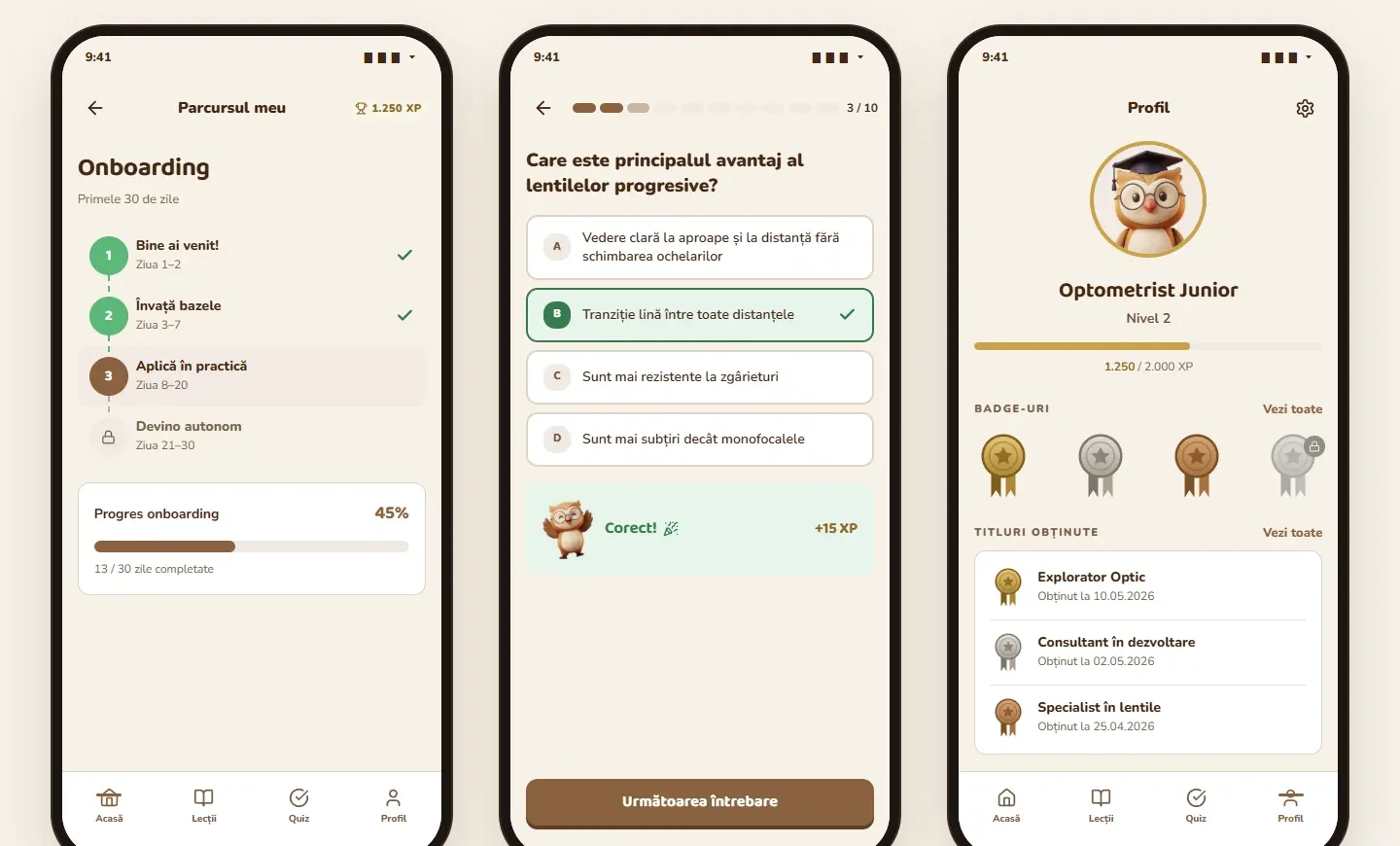
Learners follow a clear path: onboarding for the first days, then tracks by area, each with modules and lessons. A lesson means content, guided practice and then a quiz, and the next lesson only unlocks once the current one is finished.
The default quiz pass mark is 80%. It isn't just an interface rule: the check that the quiz was passed and the case studies approved runs in the database before any points are awarded, so it can't be bypassed.
Roles that see different things
The app has five roles: advisor, optometrist, trainer, area manager and administrator. An optometrist sees everything an advisor sees plus their specialist content. Trainers review case studies and award badges, area managers follow the teams in their region, and administrators write and publish the content.
The separation lives in the database, not just in the interface. If a screen ever showed something by mistake, a user without the right would see an empty screen, not someone else's data.
Motivation that doesn't feel childish
Every correct answer earns experience points; learners level up, collect badges and earn certifications at the end of each track. Mentors — four characters, each covering an area: sales, optometry, customer experience and performance — guide them along the way.
The leaderboard ranks stores, not colleagues. A store's score is the sum of its team's points, so the incentive is for the whole team to grow, not for someone to win at the expense of the person next to them.
The specification before the code
The platform started from a 45-chapter functional specification, covering everything from roles and permissions to accessibility and backups, and from its own design system, checked automatically for contrast and Romanian diacritics. The result is 41 screens designed phone-first, because staff learn between customers, not at a desk.