A town-hall site is not a brochure site
The Zătreni commune administration, in Vâlcea county, needed a website compliant with Romania’s DigiLocal framework. What makes it different from an ordinary site is that the structure is not negotiable: the law dictates which sections must exist, which documents get published, and how quickly.
The audience is different too. It is not a customer comparing offers but a citizen looking for one specific thing — a council decision, a form, the mayor’s office hours — usually on a phone and usually in a hurry. The site does not need to convince anyone. It needs to find.
The Local Official Gazette, structured as the law requires
The heart of the site is the Monitorul Oficial Local, with every category in its place: local council decisions, mayoral dispositions, draft decisions, financial documents and the status of the administrative-territorial unit.
Layered over it is the decision-transparency section — council meetings, public debates and the documents required by Law 52/2003 — plus an institutional-integrity area. These are sections a “pretty” site treats as an appendix; here they are the main architecture.
A citizen does not come to be convinced. They come to find a document. The whole design starts there.
Online services: a town hall that does not force you to queue
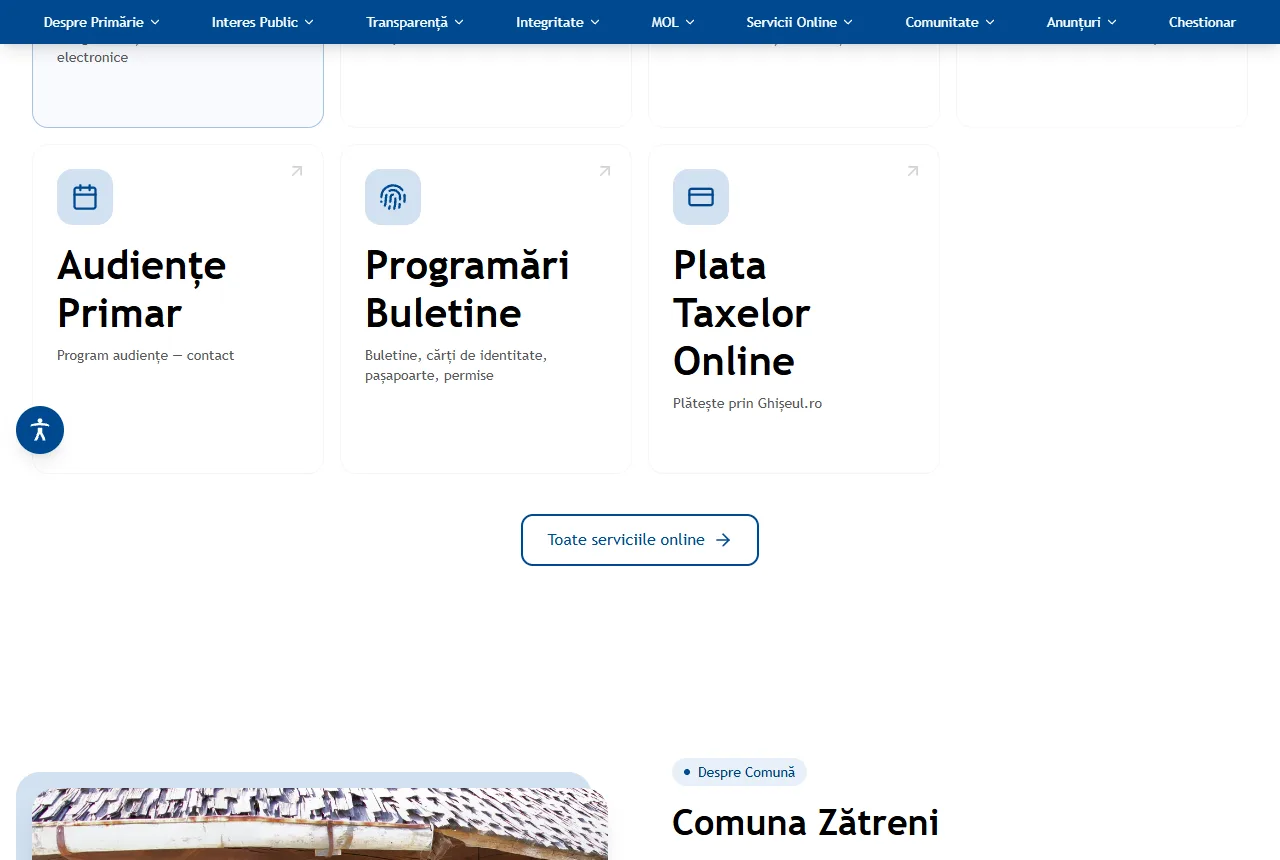
The part that genuinely changes the relationship with the citizen is the online services area: a citizen account, electronic forms, online complaints and the ability to check the status of a submitted request.
To these are added the national platform integrations — Ghișeul.ro for tax payments and the MAI Hub for appointments related to identity documents and permits. For a rural commune, that means journeys saved and a less crowded counter.
The rest of the structure covers announcements and community life: schools, the cultural centre, the library, healthcare and sport.
Accessibility is not optional here
Public websites serve people with visual impairments too, and WCAG 2.1 compliance is a requirement rather than a bonus. Contrast, text sizing, keyboard navigation and semantic page structure were treated as part of the specification, not as a final polish.
How it works now
The result is a site that behaves like a counter open around the clock: it publishes what must be published, in the required form, and lets citizens resolve online the things that would otherwise mean a trip. It is the second DigiLocal website in our portfolio, after Găești.